Automations
An automation is a prompt that CodeAlta Desktop sends by itself: at a time you choose, when an issue or a pull request is opened, when a command of yours succeeds, or when you click Run now. Each run starts a new session, so you read the result like any other work. Automations are in CodeAlta Desktop only.
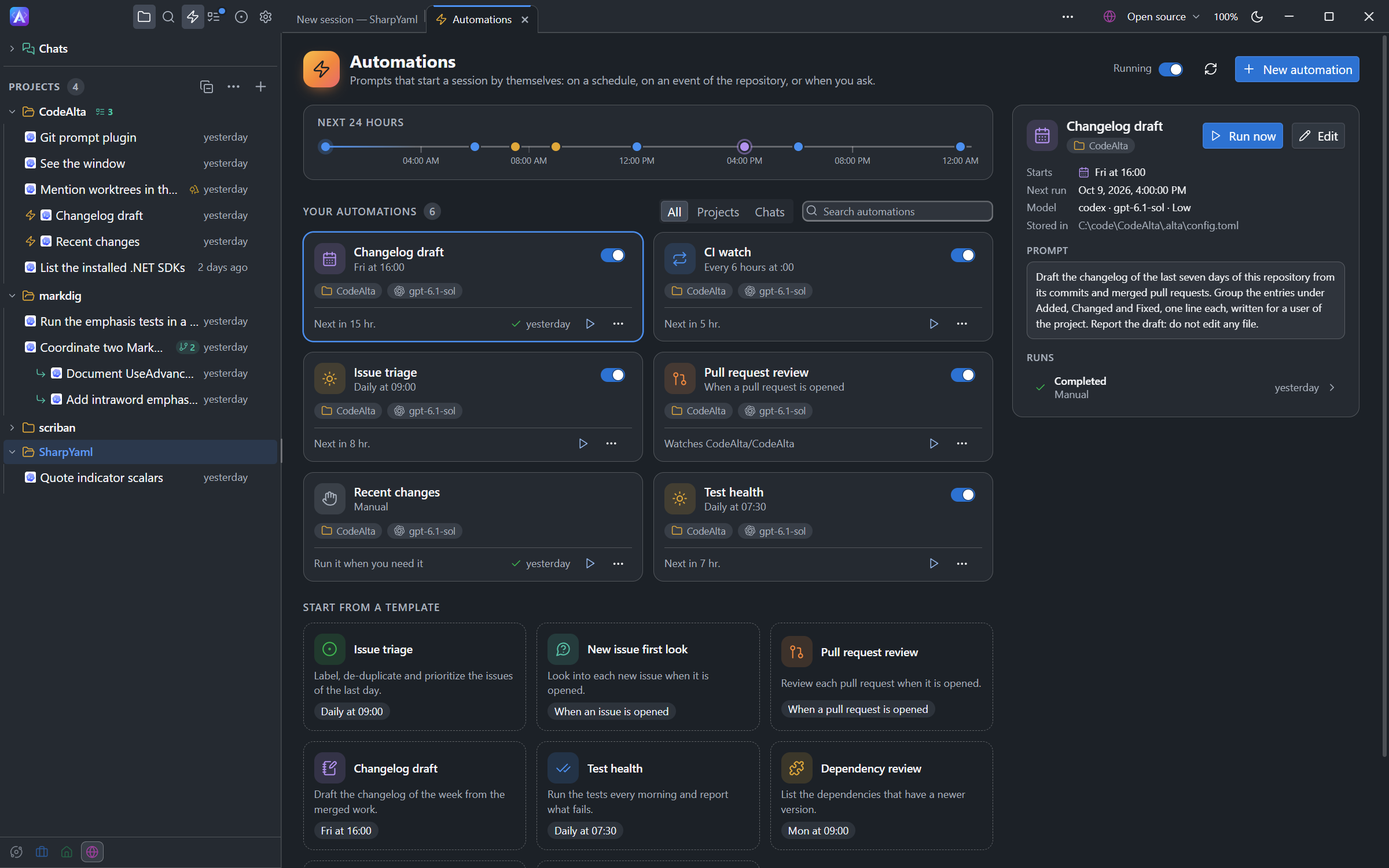
Create an automation
- Click the bolt at the top of the window, or press
Ctrl+GCtrl+M, to open the Automations tab. - Click New automation, or start from a template such as Issue triage or Pull request review.
- Choose where it runs: in a project, or as a chat in no project.
- Add what starts it and write the prompt, or choose a script.
- Choose what its sessions run with in Runs with (see below).
- Click Save, or Save and run to try it right away.
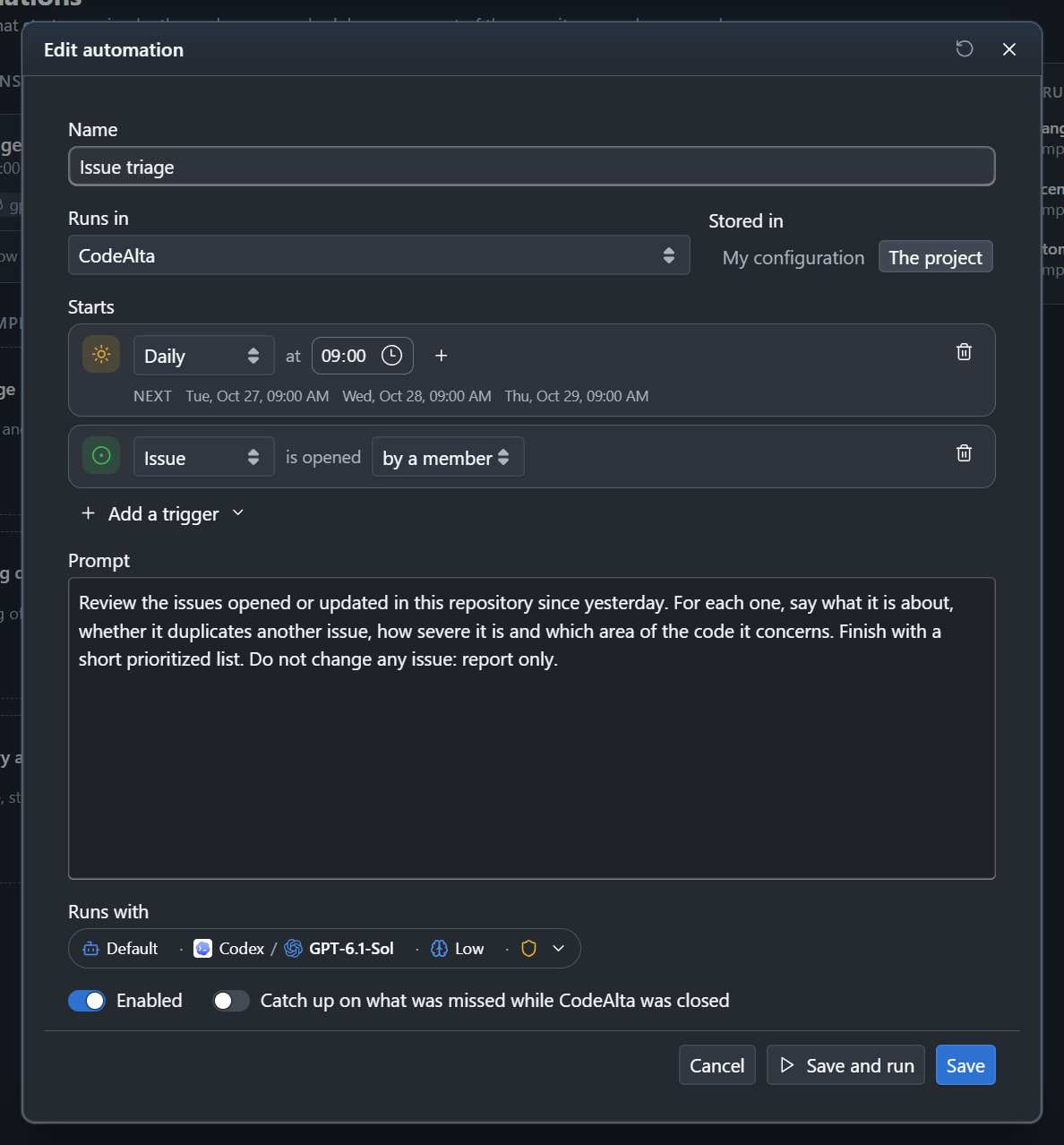
The session starts with nothing but your prompt: say what to look at and what to report.
Run a script
An automation can run a script of the library in place of a prompt. The editor offers Prompt or Script: choose the script, and write its arguments as a JSON object. The editor lists its parameters under them. The template Pull request review in parallel runs the sample review-pr on each pull request.
- Its session calls the script through
exec, even when Code Mode is off, then answers with its result. - A script that declares an
eventparameter gets what started the run in it: the issue, the pull request, or what the command printed.review-prreads the number of the pull request there. - An automation that runs a script waits for Allow until it is saved in the editor or created with
alta automation create, and asks again whenever the script changes: a version saved by an agent, or one that came with agit pull.
script = "triage-issues"
script_args = '{"limit": 10}'
An agent creates one with alta automation create --name "PR review" --trigger pull_request@opened --script review-pr, and gives the arguments with --script-args '{"lenses": ["security"]}'. The script and its arguments are checked as a run checks them.
What its sessions run with
Runs with is the Agent chip of the prompt: click it for the same form, with the agent prompt, the provider, the model, the reasoning effort, the permission mode, review before commit and the sandbox.
- Use the defaults, at the top of the form, is on for a new automation. The rows then show what a run takes, grayed: the default provider, its model and effort, and the defaults of your settings. A provider marked (first enabled) means no default provider is set.
- Turn it off to choose. What the defaults gave becomes your choice, and you change it from there.
- A provider, model or permission mode that is no longer offered stops the run, which says why.
- More options, at the end of the form, has Sub-sessions: off, the sessions of the automation do all the work themselves and start no sub-agents.
model = "codex:gpt-6.1-sol@high"
permission_mode = "acceptEdits"
review_before_commit = true
sandbox = "off"
sub_sessions = false
What starts an automation
| Trigger | When it runs |
|---|---|
| None | When you click Run now. |
| Hourly | Every hour, or every few hours, at the minute you choose. |
| Daily | Every day, at one or more times. |
| Weekly | On the days and at the times you choose. |
| Cron | When a cron expression matches, for example 0 9 * * 1-5. |
| Issue | When an issue is opened in the repository of the project. |
| Pull request | When a pull request is opened, or when it receives commits. |
| Jira issue | When an issue of the Jira project is created, or when it is updated. A project with several Jira projects watches all of them. |
| Command | When a command that CodeAlta keeps running ends with success. |
An automation can have several triggers. Times are read on the clock of your computer.
Issues and pull requests
- They work with GitHub, GitLab and Azure DevOps, with the sign-in of the issue picker.
- CodeAlta looks at the repository every five minutes. The automation shows the repository it watches.
- An automation runs for the issues and pull requests of the members of the repository. Choose by anyone to run for every author.
- The Jira issue trigger needs the Jira plugin turned on for the project.
Commands
A Command trigger is for a tool that waits for something and then ends: a script that waits for a file, or gh run watch 123 --exit-status, which waits for a workflow run of GitHub.
- CodeAlta starts the command and keeps it running. Each time it ends with exit code 0, the automation starts a session with your prompt followed by what the command printed. Another exit code starts no session. Either way, the command is started again.
- The command runs in the shell agents use: PowerShell on Windows, your shell on macOS and Linux. It runs in the folder of the project, or in your home folder for a chat. Type a folder next to the command to run it there.
- A command that ends in less than five seconds is started again after a pause, which grows up to five minutes. When it keeps failing, the automation shows its last line.
- When the command succeeds while the last session still works, the new session starts after it.
- Turning off the automation, or the Running switch at the top, ends the command.
triggers = [
  { type = "command", command = "gh run watch 123 --exit-status", cwd = "tools" },
]
Follow the runs
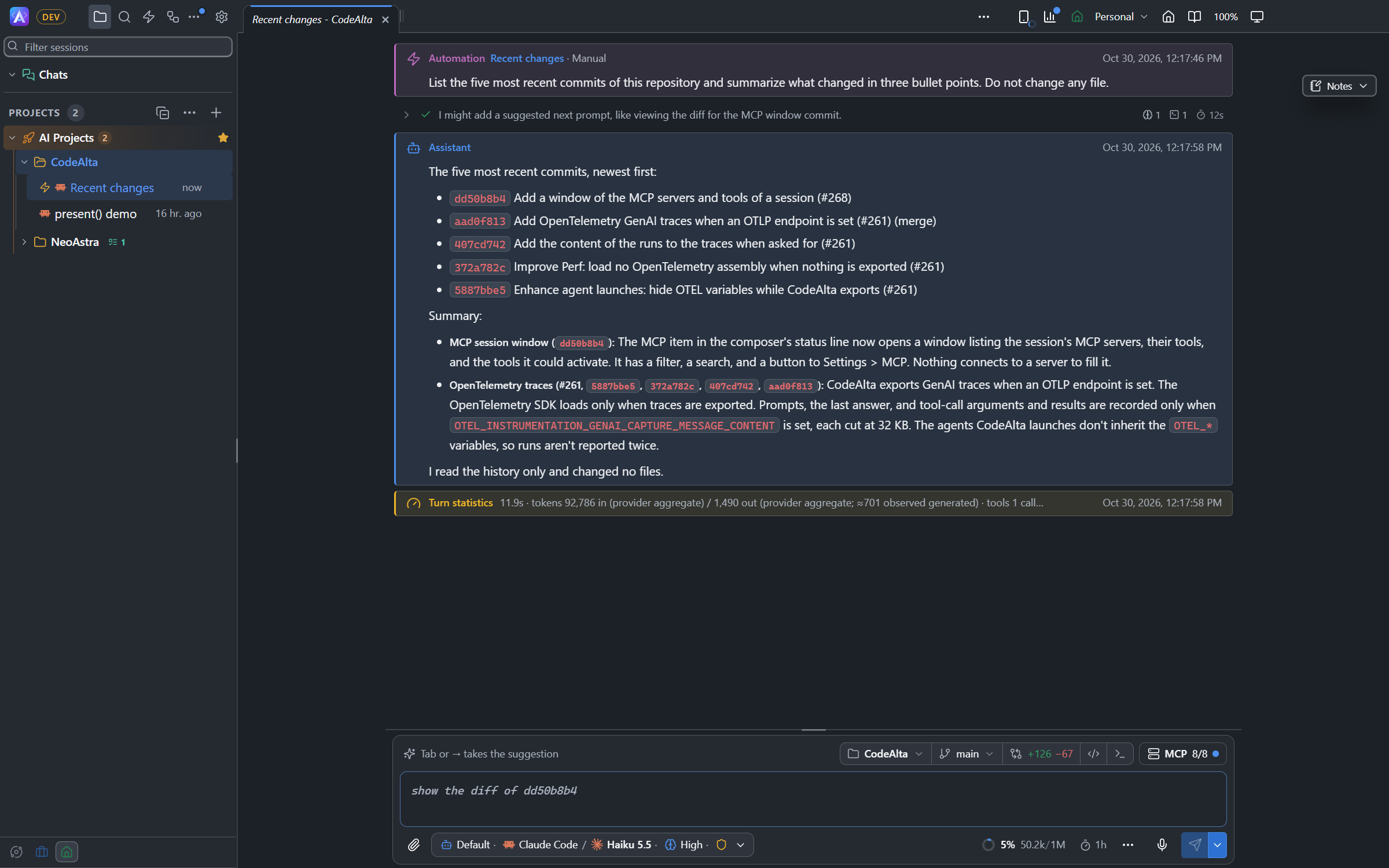
- A session started by an automation has a bolt in the sidebar. Its first card, Automation, is the prompt the automation sent: it names the automation, which you open with a click, and what started the run.
- In the Automations tab, select an automation to see its runs. Click a run to open its session.
- The switch of an automation turns its triggers off. The Running switch at the top turns off the triggers of all of them. Run now always works.
Good to know
- Automations run while CodeAlta Desktop is open, also when it stays in the notification area.
- What was due while CodeAlta was closed is skipped. Turn on Catch up on what was missed while CodeAlta was closed in an automation to run it at the next start.
- An automation is stored in My configuration (
~/.alta/config.toml) or in The project (.alta/config.tomlof its folder), which you can commit to share it with your team. - An automation that came with a project, written by someone else, waits until you read its prompt and click Allow. It asks again when its prompt, triggers or what its sessions run with change, including the command of a trigger.
- An agent can list, create and run automations. Ask in your own words, for example:
Create an automation that reviews the open pull requests every morning at 9.